Monday, April 14, 2014

Fossil Hunting in England's Jurassic - Saltwick Bay, Whitby

Greetings from Whitby, Yorkshire, home of the Dinosaur Coast and several bays granting access to both the North Sea and seaside cliffs full of Jurassic fossils.   We're finally saying goodbye to jet lag and a very welcome hello to jet black and the east coast of England.

Jet Black
Today (April 13) we went to Saltwick (pronounced 'salt tick') Bay 2 miles south of Whitby, with easy access to the sea and plentiful ammonites and belemnites.  We believe Barry found a fairly rare piece of jet black.  Bloody hell!  Jet black is petrified wood made from the extinct Araucariaceae tree, a relative of the living Monkey Puzzle tree, made fashionable when Queen Victoria made it into jewelry and wore it while in mourning for Prince Albert.  Whitby is the jet black capital of the world.


We hope one day WIPS members might consider a visit to this neck of the woods.  It really is another world and an incredible high when we sit on a rock, surrounded by seaweed, splitting shale to find a pyritized ammonite or belemnite waiting inside, or spy the rounded hint of an ammonite peeking out from a mass of boulders.

Barry above First Nab
This 'field trip' is not without its risks. January storms eroded up to seven years of cliff face within a few weeks along this coast, leaving the cliffs extremely unstable; some have been hurt recently by falling rocks from the saturated ground above, so we keep a good 4-5' distance from the base. 


We head out as the tide is going out (9:00 am this morning), which gives us time to scout around the Second Nab (rock jutting out of the water) and return to the safety of the beach area by the time high tide returns a few hours later.  Novices can get stranded facing an incoming sea and steep cliffs with no way out.  My Iowa farm upbringing didn't begin to prepare me for these water hazards.


The Middle and Lower Jurassic are exposed along the coast in the 200-600' cliffs, which are regularly eroded by storms and tides from the North Sea.  The base of the cliffs at Whitby and Saltwick Bay are Lower Jurassic.  About halfway up is the Dogger, a marker bed made of hard rock and hard nodules, and on top of that is the Middle Jurassic. 


The cliffs get older as we travel north.  Most of our finds come from the Whitby Mudstone Formation of the Lower Toarcian from the Lower Jurassic.  Unlike fossil collection in America, in the UK we can collect vertebrates.  If the site is an SSSI (Site of Special Scientific Interest), hammering isn't allowed.


Belemnite Guard


Whitby is a lovely fishing village on the Yorkshire coast, hosting the world's best ammonite museum, the home of alum, Captain Cook, Bram Stoker's "Dracula" setting at the local Abbey, various shipwrecks, and a very active fishing fleet setting out with lobster and crab cages, setting the sea gulls squawking. On our way over from the west coast, we lunched next to a 1719 fireplace, and today we walked past a 1609 fisherman's cottage and the 1401 Smugglers Pub.  What history!

After several treks with suitcases to our flat (with outstanding views overlooking red tile rooftops, Whitby Bay and the Abbey) up 44 steps, and the many uneven and steep steps up and down from cliffs to shore, Barry says even his pygidium aches, which we treat with a few pints at our new local, the Elsinore Pub.

View of Whitby Abbey across Whitby Bay from kitchen window

For more information of this fantastic Jurassic area, the best book is "Fossils of the Whitby Coast" by Dean Lomax, a WIPS member.  "The Floating Egg" by Roger Osborne, deals with this coastline.

For information on UK geology:   http://www.discoveringfossils.co.uk/locations.htm

We belong to UKAFH (UK Amateur Fossil Hunters).  Their newsletter, "Trilobite Times", is free, fun, with superb photos of their field trips collections.  Sadly we weren't able to meet up with them on this trip.  Check out their website:  http://www.ukafh.co.uk/

Cindy and Barry Smith

Monday, April 7, 2014

Fossil Hunting in England’s Jurassic - the beginning

Two of our members, Cindy and Barry Smith, are traveling this April to England.  Here begins their story:


Greetings from across the pond in Barry's childhood home, Grange-over-Sands, a tiny village in northwest England.  

Today [Apr. 7, 2014] we hiked in fresh drizzle and fog, through daffs, past sheep and over styles, to Hampsfell Hospice atop Carboniferous limestone featuring grykes, clints and runnels, the grykes sheltering fauna that grows nowhere else from the rabbits, sheep and cows.

For those who enjoy British geology:  
http://www.limestone-pavements.org.uk/documents/Grangeleafletlowres.pdf


Thursday [Apr. 10] we head west to our first of 3 Jurassic destinations, Whitby, a lovely fishing village on the Yorkshire coast, hosting the world's best ammonite museum, the home of alum, Captain Cook, Bram Stoker's "Dracula" setting at the local Abbey, various shipwrecks, and jet black (petrified wood made from the Araucariaceae tree, a relative of the Monkey Puzzle tree, made fashionable when Queen Victoria had it made into jewelry and wore it while in mourning for Prince Albert).  There we will have a few pints and collect ammonites, belemnites and, with luck, the odd marine reptile (!) between high tides from the cliffs and shores of the Upper and Lower Lias.

Our schedule:

4/10-17 Whitby on the North Sea, northeast coast of England

4/17-25 Charmouth near Lyme Regis on south coast

4/25-5/2  Castlemartin, Pembrokeshire, Wales, on the west coast
 
Tally ho!  

Sunday, May 5, 2013

Day 8 of 8: The last day - already?!!?

It was hard to believe, at this point, that this trip was nearly over.  And while most of the time we had been looking for small marine invertebrates, we still noticed this large ... vertebrate?


The route we took passed through New Mexico's north eastern corner.  On that route were two more points of interest. 
 
Shelter is across the lake, to the right of center

The first was Clayton Lake State Park Dinosaur Tracks.  The park is a few miles north of Highway 87, then there's a nice stretch-your-legs walk to the site along a path and across the dam. 

In picture to the right, you can see the site's shelter across the lake.  To the left of the shelter is the exposed track site.

The interpretive signs were well-composed and helped to find some interesting ttacks, yielding interesting scenarios, such as a dinosaur's hesitation and a rippled, mud-cracked trackway.

It would be best to visit this site when the sun's angle casts more shadows, earlier or later in the day so the tracks are more visible.  At the time of our visit the sun was too high and bright.  Yet, since a boardwalk allowed you to see tracks from all sides, there was plenty to see.


 The second stop in New Mexico was Capulin Volcano National Monument.  I learned about cinder cone volcanos, and this was a perfect example of it.  There is a road that spirals around the cone to the top.  At the top, you have wonderfully panoramic views of the Raton-Clayton volcanic field, Sangre de Cristo mountains in the distance, and portions of four states (New Mexico, Oklahoma, Texas and Colorado).

Capulin Volcano


View from the top of Capulin Volcano

Thus ends the 2013 WIPS Texas trip.  I'm hoping to collect photos from participants of the fossils they found.  If I can, and they've been identified, I'll try to get them posted here.  If not, well, look for the next trip story!


Day 7 of 8: Two more Fossil-Hunting stops

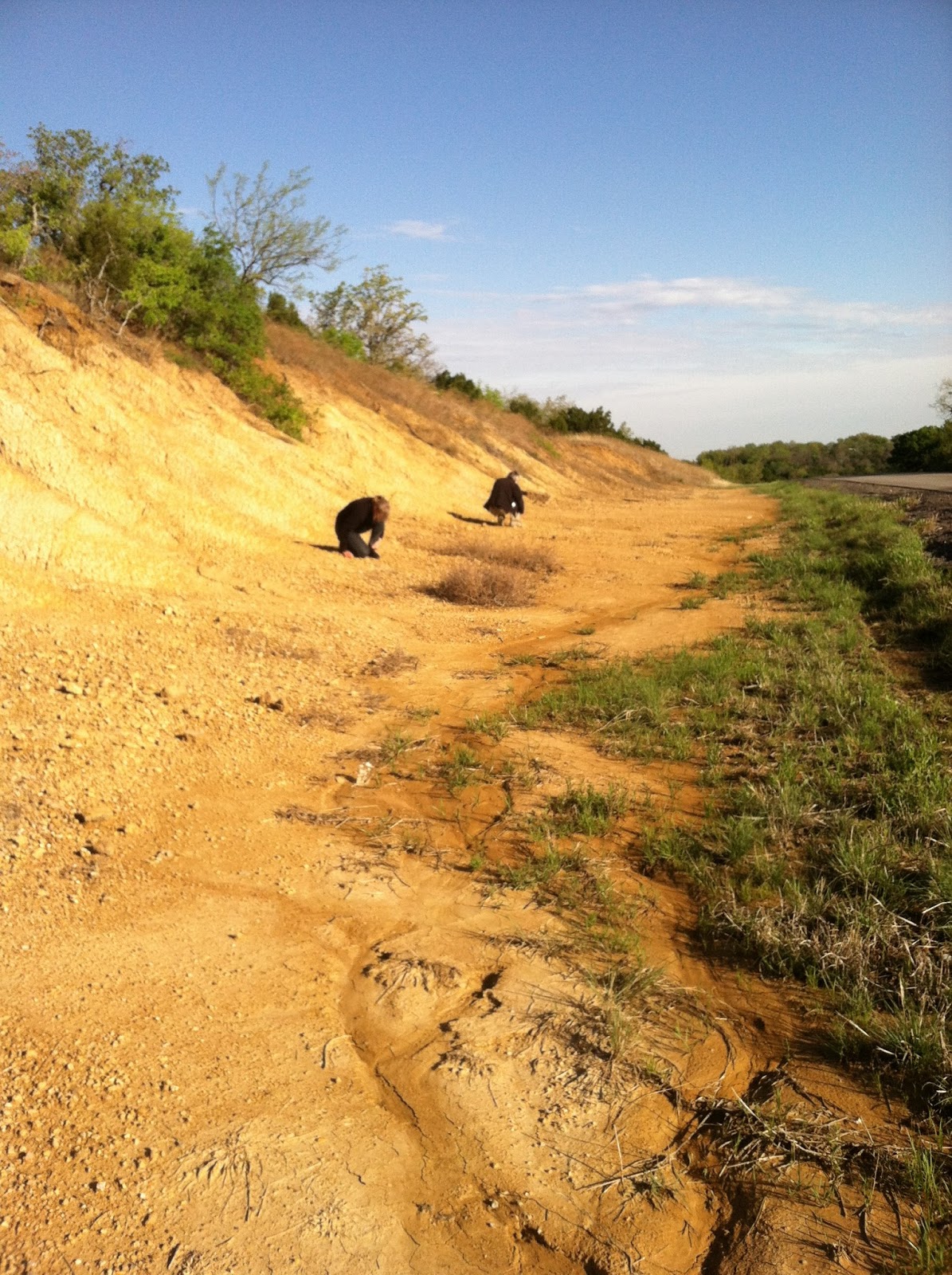
We awoke in Mineral Wells with plans for another site near to the town.  While many of our group parted for other adventures, we still had 4 cars' worth of people.  North of town is a road cut in late Pennsylvanian strata.  There we sought and found calyxes of a type of stemless, free-floating crinoid.  Then we started finding all sorts of other types of marine fossils such as gastropods, horn corals, and clams.  (After the trip I've learned that Dennis compared finds from this location to those of the Mineral Wells Fossil Park and there was no overlap of species!)


While we were on hands and knees early this Friday morning, a local drove up and said she was off to her yoga class but if we were still going to be there in a couple of hours, she'd take us up on her property, the fence of which was up the slope over our heads.  We could not go without her as her dogs would not be happy.  She is Lucy, a Natural Dog Trainer.


We thanked her saying that we'd probably not be there that much longer and she left, presumably to attend her class.  It wasn't very long until Lucy returned saying she'd go to a later class so come on up because there should be lots more fossils on her property.  It was a lovely day and we scrambled up the slope, over a fence, and across to a gully. 


Lucy's pointing towards that gully

Down the gully we clambered.  There we found many pebbles, some pretty flowers, a shaly outcrop with some oysters and a few nautiloids.  It wasn't quite as rich as hoped but, Lucy explained, it hadn't rained in a while - usually there were lots more.

After this stop, another car's participants had other plans, so three headed west and north.  We had one more fossil-hunting potential for this trip, at an outcrop of lower Cretaceous strata.  This locality was a few miles north of a community called Fluvanna. 


There were plenty of echinoids - I've been calling them heart urchins but they might be of the Macraster genus.  There were some gastropods and ostrea.  The coolest finds, by the Langstons, are probably Salenia mexicana!


When we finally decided we'd made a complete pass over the outcrop, we headed on to stay the night in Amarillo.

Thursday, April 11, 2013

Day 6 of 8: Seaways Cretaceous and Pennsylvanian


After yesterday's sorry weather, today's was just perfect!  Even better, our drive through the Dallas/Fort Worth metroplex was not quite as scary as expected.  We made it to Benbrook Lake, which is southwest of Fort Worth. 


At the spillway we collected several kinds of gastropods, echinoids, bivalves, and a couple of ammonites.

After Benbrook, we had considered inserting a jaunt to Glen Rose, to see dinosaur tracks, but felt it would add too much driving, not enough fossiling.  The vote was to go on to Mineral Wells.


There is a fossil park at Mineral Wells, secured by the Dallas Paleontological Society.  It is truly a nice park and there is a sign board there, well designed to show what fossils may be found at the sight.


We found many of the depicted fossils.  They are abundant, and very tiny.  It almost made you cringe to walk there because you could hear little crunches...


I had a ball; I think most of us did.  There were just so many types of fossils to look for!  Not to mention I found something I've had on my list to find for a long time - a crinoid calyx!


It was nice that we didn't have far to drive when we finally dragged ourselves away from fossil hunting.  Mineral Wells is not very big, but they have a fun restaurant called Mesquite Pit.  (Mesquite is a tree often used for grilling.)  Just walking in and smelling the aroma made your mouth water.

It's hard to believe we've already had so much of this trip.  The next two days will be directed back to Colorado.  The fun isn't over, though, we still have several stops to go!

Day 5 of 8: Freezing at Lake Jacksboro; DPS dinner and a show

The weather took a strong turn to the worse this morning!  Thunderstorms and cold greeted us.  Several whipped out their electronic device du jour to see when the rain would pass and how warm it was supposed to get.  Since it would take an hour or so to reach the day's destination, we figured the rain would have passed by then. 

So instead of being rational, we drove out to Lake Jacksboro.  I and a few fans of fossil nuts elected to stay warm and dry.  The rest bundled up to trudge the 3 quarters of a mile across a dam to the site.


Proof they made it across to look for fossils...


   I happily turned on an e-book, periodically checking my own electronic device (my smart phone) to check the rain's progress.  After about 20 minutes it looked like the rain was done.  10 more minutes and I'd finally talked myself into going out to look for fossils.  I stepped out of the car only to see fossil hunters coming back across the dam.


There were a few nice finds, once hands thawed enough to uncurl around them:

Ammonites and Gastropods

Brachiopods
We returned to the Dallas area, staying in a hotel near Brookhaven College.  The Dallas Paleontological Society meets there on the second Wednesday of the month, in the Geotechnology Institute building.  I don't know if this is typical, but the DPS members all brought in food.  We were invited to enjoy it, and so we did!


Dinnertime included show and tell.  The members had lots of fossils to discuss.  It was fun to see the passion in the room.

Day 4 of 8: Riverbeds

The hotel in Sherman was nice (I sure slept well there...).  After breakfast we drove out to meet Bill Johnson, of DPS.  He then led us to Ladonia, TX, or just outside it, to the Pete Patterson Fossil Park.  This is actually a location on the North Sulphur River.

Beside a bridge is a kind of staircase that takes you to the river.  Thank goodness because the banks here are high and steep.  In the 1920's, the Corp of Engineers straightened the river, revealing fossil-rich layers.


It is a frequently visited site and unless some heavy rains have exposed additional fossils, not many will be there to find.  At the time of our visit, we found a few tantalizing bits, just enough to make us want to return after a rain.  Still, finds included pretty pieces of baculites, ammonites, and gastropods.  Jill found a wonderful Enchodus tooth:


Just to be sure we were hooked on coming back, DPS member Don and Jane Fagerstrom gave us a tour of their collection.  Oh, my!  They hav
e a LOT of shark's teeth, plesiosaur vertebrae, and other fantastic fossils.  The biggest beauty was the Tylosaur skull.


After the tour, we headed back west and stopped just outside of Sherman (where we woke up this morning) at Post Oak Creek.  We collected pelecypods and sharks teeth.  It was amazing how quiet folks can be when focused on fossils.  We simply assumed the position and looked: